
The Presumptive Taxation Scheme for professionals, governed by Section 44ADA under the old Act and now Section 58 of the Income Tax Act 2025, is one of the most misunderstood provisions in Indian income tax. Thousands of doctors, lawyers, architects, engineers, chartered accountants, IT professionals, and freelancers use this scheme every year without fully understanding how it works, when it benefits them, and what it actually requires.
This free guide is written by a practising Chartered Accountant with over 25 years of experience. It explains presumptive taxation for professionals in plain language, from eligibility and income calculation to books of accounts, GST registration, and the salary versus professional fees decision.
Who Can Use Presumptive Taxation Under Section 44ADA?
The presumptive taxation scheme under Section 44ADA (now Section 58 of the Income Tax Act 2025) is available to specified professionals in India. If you fall into any of the following categories, this guide applies directly to you:
- Doctors and medical practitioners: physicians, surgeons, dentists, and specialists in private practice
- Lawyers and advocates: individual practitioners and law firm partners
- Architects and engineers: independent consultants and practising professionals
- Chartered Accountants and Cost Accountants: practitioners in individual or firm capacity
- IT professionals and software consultants: freelancers and independent technology professionals
- Company Secretaries: practising CS professionals
- Technical consultants and interior designers: specified professionals under Section 62 of the new Act
- Freelancers and independent consultants working across multiple clients
If you earn professional income in India, this guide is for you.
What Does This Guide on Section 44ADA and Section 58 Cover?
This guide covers nine chapters on presumptive taxation for professionals under Section 44ADA and Section 58 of the Income Tax Act 2025, from basic eligibility to the salary versus professional fees decision.
Chapter 1: What Is Presumptive Taxation?
What the scheme is, why it exists, and the key terminology changes under the Income Tax Act 2025 including the abolition of Assessment Year and introduction of Tax Year.
Chapter 2: Who Is Eligible Under Section 44ADA?
Who qualifies as a specified professional under Section 62, the gross receipts limits, and the critical LLP exclusion that many firms get wrong.
Chapter 3: Gross Receipts Limits Under Section 44ADA
The Rs. 50 lakh and Rs. 75 lakh thresholds explained, what counts as gross receipts including reimbursements, the 95% digital receipts condition, and what happens if you cross the limit mid-year.
Chapter 4: How Is Your Taxable Income Calculated?
How the 50% versus actual profit rule works, and the most common and costly misconception about the scheme that is causing professionals to underreport income.
Chapter 5: Eligible Business Expenses for Professionals
Every expense a specified professional can legitimately claim, from office rent and staff salaries to vehicle costs, equipment depreciation, and professional indemnity insurance.
Chapter 6: Books of Accounts Under Section 62
What Section 62 actually requires, what the Section 58 procedural exemption actually means, and why maintaining records matters even under the presumptive scheme.
Chapter 7: GST Registration for Professionals
When GST registration is mandatory, the Rs. 20 lakh threshold, the medical professionals GST exemption, and key compliance points once registered.
Chapter 8: Salary or Professional Fees: Which Is Better?
The tax and compliance implications of each structure, the expense deduction advantage of professional fees over salary, and what to ask your CA before deciding.
Chapter 9: Should You Choose Presumptive Taxation?
A five-step decision framework that helps you decide whether the presumptive scheme genuinely benefits you this year based on your actual profit margin, GST position, and expense profile.
Section 44ADA is Now Section 58: What Changed Under the Income Tax Act 2025
The new Income Tax Act 2025 came into effect from 1st April 2026. For professionals under the presumptive taxation scheme, here is what changed.
Section numbers have changed.
Section 44ADA of the old Act is now Section 58, Serial Number 3 of the Income Tax Act 2025. Section 44AA (books of accounts) is now Section 62. Section 44AB (tax audit) is now Section 63.
Assessment Year has been abolished.
Under the old Act, income earned in Previous Year 2026-27 was filed under Assessment Year 2027-28. Under the new Act, income earned in Tax Year 2026-27 is filed and referenced under Tax Year 2026-27 itself. All notices and assessment orders now carry only the Tax Year reference.
The substance of the scheme is unchanged.
The eligibility conditions, gross receipts limits, and the 50% deemed income computation all continue in their familiar form. What has changed is the section numbering and year terminology.
This guide uses new Act section numbers throughout, with Section 44ADA references noted for those familiar with the old Act.
The 50% Deduction Misconception Under Section 44ADA: Corrected
The most widespread misunderstanding about presumptive taxation for professionals is this: many professionals believe that Section 44ADA gives them a flat 50% deduction on gross receipts, automatically, without needing to know their actual profit.
This is incorrect.
The provision states that your taxable income is 50% of gross receipts or your actual profit, whichever is higher. If your actual profit exceeds 50%, you must declare actual profit. Declaring 50% when your actual profit is higher is underreporting, which is a clear violation under the Income Tax Act 2025.
The presumptive scheme gives you compliance simplicity, not a guaranteed tax reduction. Whether it also reduces your tax depends entirely on your actual profit margin and your actual business expenses.
Chapter 4 of this guide explains this in full with worked examples showing exactly when the scheme helps you and when it does not.
Do Professionals Need to Maintain Books of Accounts Under the Presumptive Scheme?
This is one of the most searched questions on Section 44ADA, and most answers you will find online are incomplete.
Under Section 62 of the Income Tax Act 2025, specified professionals are required to maintain books of accounts unconditionally, regardless of income level. The Section 58 presumptive scheme provides a procedural exemption from producing books during assessment. It does not exempt professionals from the obligation to maintain them.
More importantly, to correctly apply the scheme you must know your actual profit, because you must declare actual profit if it exceeds 50% of gross receipts. And to know your actual profit, you need accounting records.
Chapter 6 of this guide explains the correct position in full, what maintaining books actually means in practice, and which accounting software most professionals use.
About the Author: Practising CA with 25 Years of Experience

Amit Mundhra is a Fellow Chartered Accountant with over 25 years of practice experience. He specialises in income tax litigation, statutory audit of listed companies, GST advisory, and virtual CFO services. He also heads the firm’s international bookkeeping practice serving clients in the United States, United Kingdom, Australia, and UAE.
He writes on practical tax and compliance matters with a focus on making complex provisions accessible to business owners and professionals.
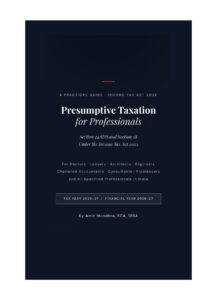
Free Download: Presumptive Taxation Guide for Professionals (Section 44ADA / Section 58)
Presumptive Taxation for Professionals
Section 44ADA and Section 58 of the Income Tax Act 2025
Tax Year 2026-27 (Financial Year 2026-27)
By Amit Mundhra, FCA, DISA
Format: PDF · Free · No sign-up required · Direct download
This guide is an educational resource prepared by Karnani and Co., Chartered Accountants, Jaipur. It does not constitute professional tax advice. Readers should consult a qualified Chartered Accountant for advice specific to their situation.
Need Tax Advice on Presumptive Taxation for Your Professional Practice?
This guide covers the general provisions of presumptive taxation under Section 44ADA and Section 58 for all specified professionals. Every professional’s situation is different. Your gross receipts, expense profile, GST position, and income structure all affect which approach works best for you.
If you would like to discuss your specific situation, Karnani and Co., Chartered Accountants would be glad to help.
Write to us at amit@karnanica.com or visit www.karnanica.com to learn more about our services.
Frequently Asked Questions on Presumptive Taxation Under Section 44ADA
What is the limit of presumptive tax for professionals?
The gross receipts limit for professionals under Section 44ADA (now Section 58 of the Income Tax Act 2025) is Rs. 50 lakh if cash receipts exceed 5% of total receipts, and Rs. 75 lakh if 95% or more of receipts are through digital or banking modes.
Is it compulsory to opt for Section 44ADA for 5 years?
No. The five-year lock-in rule applies only to businesses under Section 44AD (now Section 58 Sl. No. 1). Professionals under Section 44ADA (now Section 58 Sl. No. 3) can opt in and out of the scheme each year freely with no restriction.
How to calculate presumptive income under Section 44ADA?
Your taxable income under Section 44ADA is either 50% of your gross receipts or your actual profit, whichever is higher. To know which is higher, you must first compute your actual profit by deducting eligible business expenses from gross receipts.
Who is not eligible for presumptive taxation under Section 44ADA?
LLPs, companies, non-resident professionals, and HUFs are not eligible for the professional presumptive scheme under Section 44ADA. Professionals whose gross receipts exceed the applicable limit are also not eligible. Management consultants, graphic designers, coaches, and other non-specified professions cannot use the professional scheme.
Can a person claim both Section 44AD and Section 44ADA?
If you have both business income and professional income from clearly separate activities, Section 44AD may apply to the business portion and Section 44ADA may apply to the professional portion. Whether both can be used simultaneously depends on the specific facts of your case. Consult your CA before applying both schemes in the same return.